One of the most powerful things we can give kids is the opportunity to hear someone else's story and encourage a widening of their lens. Through our WAWOS In Schools program, we bring disability representation directly into classrooms. The goal isn't simply to talk about differences; it's to create the kind of honest, human conversations that help kids understand them -- and, ultimately, see one another beyond a diagnosis or physical disability.
Ryan Day and his son have been part of the WAWOS community for several years. Their family understands how meaningful it can be for a child to feel seen, valued, and included -- and how empowering it is when kids are given the opportunity to share their own stories.
As educators and students return to the classroom for another academic year, Ryan took the time to share his experience with WAWOS In Schools and its impact. Read on to learn more.
[contributed by Ryan Day]
The classroom came alive when Paralympic athlete Catarina Guimarães appeared on the big screen, smiling and catching her breath during a break from training outside the U.S. Paralympic training facility. For all but one of the students, this was the first time they had a chance to speak with a Paralympic athlete and boy, did they have questions.
"How long do you work out?"
"What do you eat?"
"How many medals have you won?"
They were in awe of her incredible accomplishments — not as someone with a disability, but as a world-class professional athlete. They also heard about the hard work and challenges she faced. They could have quite literally kept talking to her all afternoon if she didn’t need to return to her training.
WAWOS in Schools uses conversation and personal stories to demystify physical differences, helping students understand and become allies to people whose bodies move or work differently. WAWOS founder, Jacquie Robison, led a one-hour interactive session in each of the three fifth-grade classes. I joined my son, who is one of those students, and is also a stroke survivor. It was incredible to see WAWOS at work in his school.
Jacquie started each session by sharing the story of how raising her daughter, now an amazing high schooler with cerebral palsy diagnosis, led her to advocate for all kids with physical differences to be seen and included. When her daughter noticed that people would act differently when she was using her walker, Jacquie challenged herself to find a way to embrace the difference and created the “walkercape,” a signature tool of WAWOS to normalize the difference and create an opportunity for connection. Suddenly, people would comment on the ballerina-themed walkercape and engage with her daughter. Anyone with a visible difference has seen how it distances people from them and can make them feel isolated. WAWOS turns that distance into curiosity and connection, helping kids feel seen and valued.
Near the end of each session, my son shared his personal story. It was powerful to see him, one of their own classmates in the fifth grade, take the floor to talk about the stroke at age 6 that caused hemiparesis and changed his life. He shared what it was like at the moment the stroke started, that it was scary not being able to move his body or talk. He joked about how the ER was expecting a 60-year-old because “6 year olds aren’t supposed to have strokes.” 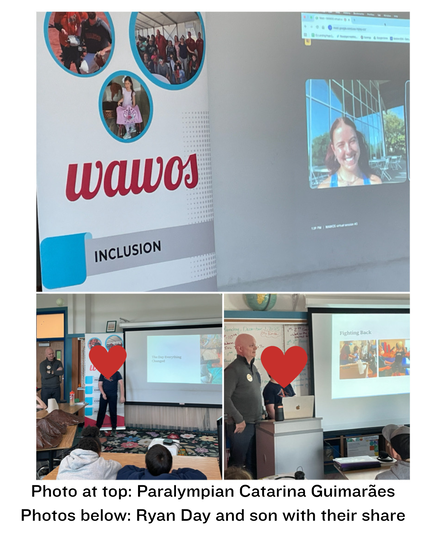 He showed photos of himself playing with his brother before the stroke, then in the ER, half-paralyzed with EEG wires attached to his head. The photo of him lying pale and unconscious, hooked up to machines, seemed to hit the class especially hard. I could feel their collective hearts sinking at the gravity of his situation. Finally, he told the story of his recovery, and all of the activities that he enjoys doing today like pitching for his baseball team and skiing.
What struck me most was how focused and attentive the other students were while he was telling his story. He has dealt with a few classmates at school being unkind about his physical differences. They were in the room that day, and I believe that each of them came away changed in some small way by hearing his story. They can no longer think of him only as the kid with a physical difference. They now know that he is the kid who endured a stroke at six years old and worked and willed his way back.
After each session, classmates came up to him to express sentiments like, “you’re really brave”, or “great job”, and “I can’t believe you went through that — wow.” Telling his story gave him agency over the narrative, but it also created a deep awareness among his classmates of the importance of seeing the whole person. That transfers well beyond how they interact with him.
Connection over curriculum
WAWOS in Schools didn’t ask fifth graders to memorize definitions or study abstract lessons about disability and inclusion. It gave them stories, conversations, and people to connect with. Once they knew more about Jacquie’s daughter, Catarina, and my son, the classmate they saw every day, their perception of physical difference had shifted, and it broadened their lens and deepened their understanding.
The clearest sign that WAWOS in Schools had a big impact: more kids started saying “hi.”
WAWOS is a registered 501 (c) 3 charitable organization